
This post contains affiliate links, meaning I may receive a commission on purchases made through my links. Your support is deeply appreciated.
Prepare to be amazed by these sourdough cinnamon rolls! They are incredibly soft, irresistibly delicious, and yes, you absolutely *can* achieve this perfection using sourdough. Forget everything you thought you knew about cinnamon rolls; this recipe elevates them to an entirely new level, blending traditional flavor with the remarkable benefits of natural fermentation.

Why Choose Sourdough for Your Cinnamon Rolls?
Many of you are familiar with my immensely popular Quick & Heavenly Cinnamon Rolls recipe, which uses active dry yeast. That recipe has earned a devoted following for a reason – it consistently delivers what many consider the best cinnamon rolls on the planet. However, the journey into sourdough baking offers an exciting and deeply rewarding alternative.
I embarked on creating a sourdough version of this beloved recipe for several compelling reasons. Firstly, it’s entirely possible to achieve the same phenomenal taste and texture with sourdough. Secondly, sourdough imparts a unique, complex flavor profile that is simply unparalleled. And thirdly, in my humble opinion, sourdough represents the pinnacle of bread-making, offering a superior method for almost any baked good.
This sourdough adaptation retains all the amazing qualities of the original recipe, from its incredible softness to its mouth-watering flavor, while infusing it with the profound benefits of sourdough fermentation. It has already garnered its own loyal following among sourdough enthusiasts, proving that the magic of natural yeast can transform even the most classic treats.
Sourdough can appear daunting at first glance, but I promise you, the rewards far outweigh any initial apprehension. You might even find yourself surprised by how quickly you master the techniques and become captivated by this ancient art. Once you start, you might never want to stop!
So, if you’re going to indulge in a cinnamon roll – and you absolutely should! – why not make it a sourdough cinnamon roll? It’s a choice that not only elevates the flavor experience but also offers a wealth of health advantages.
Sourdough: More Than a Trend, A Timeless Tradition
Sourdough is far from a fleeting trend; it’s a profound return to the foundational principles of bread making, echoing how our ancestors nourished themselves for millennia. Imagine a time hundreds, even thousands, of years ago, when the very first loaf of leavened bread emerged from the oven. That bread, without exception, was sourdough. From the dawn of bread-making until the early 20th century, every single leavened loaf was raised by natural yeast. Across countless cultures, countries, and continents, our forebears relied on sourdough for their daily bread.
This isn’t merely a “COVID trend” that emerged during recent lockdowns. It is a lost culinary art, a forgotten chapter of history, and fundamentally, the *proper* way to create bread. Moreover, it is undeniably the most *healthy* way to consume bread, transforming grains into a more digestible and nutrient-rich food.
The terms “sourdough” and “natural yeast” are often used interchangeably, both referring to the symbiotic culture of wild yeasts and lactic acid bacteria that naturally leavens bread. This method was the undisputed standard for thousands of years until the early 1900s, when industrialized quick yeast burst onto the scene. Quick yeast offered unprecedented speed and convenience, enabling mass production at an accelerated rate. It quickly revolutionized the baking industry, becoming the predominant method for leavening bread worldwide.
While quick yeast brought efficiency, I firmly believe that this shift ultimately did not serve our health or palates well. My personal mission is to help revive the forgotten art of sourdough, guiding others to rediscover the deep satisfaction and numerous benefits of baking with natural fermentation.
Natural Yeast Versus Industrialized Yeast: A Deeper Dive
The differences between breads made with sourdough and those leavened with commercial yeast extend far beyond just flavor. While sourdough breads boast a richer, more profound taste with that iconic, subtle tang, they also offer a multitude of digestive benefits that quick-yeast breads simply cannot provide. In fact, many of the reasons commonly cited for quick-yeast breads being “unhealthy” are precisely the areas where sourdough shines as a superior alternative.
- **Stabilized Blood Sugar and Lower Glycemic Index:** Sourdough undergoes an extended fermentation process. During this time, the complex starches in the grain are gradually broken down into simpler sugars, which are then consumed by the yeasts and beneficial organic acids. Critically, these organic acids, particularly lactic and acetic acids, play a significant role in slowing down the rate at which glucose is released into the bloodstream. This means that consuming sourdough bread can potentially **lower the glycemic index of the current meal and even subsequent meals**, contributing to more stable blood sugar levels. This is a significant advantage, especially for those managing blood sugar or seeking sustained energy.
- **Enhanced Digestibility:** The prolonged fermentation process inherent to sourdough preparation allows the natural yeast and bacteria to “pre-digest” the grain. They break down complex carbohydrates and proteins, including gluten, into simpler, more easily absorbed forms. This enzymatic activity makes sourdough bread **significantly easier to digest** for many individuals compared to conventional quick-yeast breads, which often pass through the digestive system with many components still intact.
- **Improved Gluten Tolerance:** For a substantial number of people with non-celiac gluten sensitivity, sourdough bread can be a game-changer. The fermentation process effectively breaks down a significant portion of the gluten proteins that typically cause discomfort. While not a cure for celiac disease, many individuals who experience sickness, bloating, or digestive issues from conventionally fermented wheat products often find they can tolerate sourdough without any problems. This is due to the extensive breakdown of gluten and other challenging compounds during the long fermentation.
- **Prebiotic Powerhouse for Gut Health:** Sourdough starter itself is a thriving ecosystem of beneficial probiotics. While the baking process typically deactivates most live probiotic cultures, the long fermentation fundamentally alters the grain, transforming indigestible fibers into **prebiotic fuel for our healthy gut bacteria**. This means sourdough bakes actively nourish the beneficial microorganisms in our digestive system, contributing to a robust and balanced gut microbiome, which is crucial for overall health.
- **Phytic Acid Neutralization:** This is a monumental benefit of sourdough: its ability to **neutralize phytic acid**. Understanding phytic acid and how sourdough addresses it is key to appreciating its nutritional superiority.
Unpacking Phytic Acid: The Antinutrient Challenge
Phytic acid, also known as phytate when it binds with minerals, is a naturally occurring antinutrient found predominantly in the outer layers of grains, nuts, seeds, and legumes. Its primary concern from a nutritional standpoint is its strong ability to bind to essential minerals such as magnesium, iron, calcium, and zinc. When phytic acid binds to these minerals, it forms insoluble complexes, making the minerals unavailable for absorption by our bodies. This effectively reduces the bioavailability of vital nutrients in the food we consume.
Traditionally, methods like soaking, sprouting, and fermentation have been used to reduce phytic acid levels in foods. The most effective way to neutralize or break down phytic acid is through the action of an enzyme called phytase. Unfortunately, humans do not produce a sufficient amount of this crucial enzyme in their digestive system to effectively counteract phytic acid’s effects.
However, and this is where the magic of sourdough truly shines (cue the drum roll, please!), the lactic acid bacteria abundant in a sourdough starter naturally produce… **PHYTASE!** This means that sourdough fermentation actively breaks down and neutralizes phytic acid present in grains. Hallelujah! It’s almost as if sourdough is nature’s ingenious mechanism for helping us extract the maximum nutritional value from our food. Without grains being properly fermented, especially with sourdough, our bodies are simply unable to fully access the wealth of nutrition locked within them.
This revelation is truly significant and underscores why I am so deeply passionate about promoting sourdough baking. It’s not just about taste; it’s about unlocking the full potential of ancient grains for optimal health.

The Time Commitment: Is Sourdough More Demanding?
Yes, it’s true. Sourdough baking does demand a greater time investment compared to recipes that rely on commercial active dry yeast. While a quick-yeast cinnamon roll recipe might take approximately 2 hours from start to finish, the sourdough equivalent can span up to 24 hours or even more, depending on your chosen fermentation schedule and ambient temperatures. It is, undeniably, a labor of love.
However, it’s crucial to distinguish between “total time” and “hands-on time.” The amount of active involvement you dedicate to mixing, kneading, and shaping the dough remains largely the same. The significant difference lies in the rising times, which are considerably longer with sourdough. Each rise requires patience, as the dough slowly ferments until it has visibly doubled in size. This can take anywhere from 3 to 8 hours per rise, sometimes even longer, influenced by factors like your starter’s activity and the warmth of your kitchen.
But here’s the ultimate question: Is this extended time investment truly worth it? **ABSOLUTELY!** The deep flavors, superior texture, and unparalleled health benefits that sourdough imparts make every minute of waiting worthwhile. It’s an investment in a richer, more wholesome, and infinitely more satisfying culinary experience.
Exploring the Unique Flavor Profile of Sourdough
Describing the taste of sourdough with mere words can be challenging, as it encompasses a depth and complexity that must be experienced firsthand. Does sourdough taste sour? Yes, there’s often a subtle “tang” to it, but it’s not an overwhelming sourness. Perhaps the most accurate descriptor is that it tastes more “deep.” The flavor possesses a fantastic, intricate *depth* that sets it apart. It’s truly delicious, offering a nuanced profile that evolves with your palate. Here are a few observations about the distinctive taste of sourdough:
1. Sourdough is an Acquired Taste (in the best way!): When I first transitioned all my baking to sourdough a few years ago, my family, including my kids and husband, were initially hesitant. Beloved items like waffles and their favorite white sandwich bread suddenly carried a mild tang. It was undeniably different, and for about a month, there were protests. But gradually, our taste buds adapted and began to truly appreciate that subtle, complex flavor. Now, after more than two years of almost exclusively enjoying sourdough baked goods, we find that conventional, non-sourdough breads often taste bland or “flat” in comparison. We genuinely prefer the rich, developed flavor of sourdough.
2. Sweeteners Can Mellow the Tang: If you’re concerned about an overly sour taste, rest assured that the flavor can be easily moderated. In recipes like these cinnamon rolls, the prominent sweetness from the honey, brown sugar, and frosting beautifully balances the sourdough’s natural tang, resulting in a perfectly harmonious and less overtly sour profile. The sweetness shines through, complementing the subtle depth of the sourdough.
3. Lengthening Fermentation Increases Sourness: For those who relish a more pronounced sourdough tang, a longer fermentation period is your key. Placing the dough in an airtight container and refrigerating it for 24 to 72 hours allows the lactic acid bacteria to continue their work at a slower pace, producing more acetic acid, which contributes to a more distinct sour flavor in your final bake.
4. Incorporating the “Hooch” for Extra Tang: “Hooch” is the liquid that can accumulate on top of your sourdough starter, typically a clear or brownish layer. It’s a natural byproduct of the starter’s metabolism and often has a pungent, sour, or alcoholic aroma. While many bakers pour off the hooch when feeding their starter, stirring it back in will integrate those concentrated sour flavors into your dough, intensifying the tang of your sourdough bakes.
5. Counterintuitive Starter Ratio and Sourness: This might seem counterintuitive, but it’s a fascinating truth: generally, **the more sourdough starter a recipe contains, the *less* sour the final product will be, and vice versa.** This is because a higher percentage of starter leads to a faster and more vigorous fermentation. A quicker fermentation cycle often means less time for the acetic acid (which contributes the sharpest sour notes) to develop significantly. Conversely, a lower percentage of starter results in a slower, more prolonged fermentation, allowing acetic acid to build up and produce a more pronounced sourness.
Essential Ingredients for Perfect Sourdough Cinnamon Rolls
Understanding each ingredient’s role and selecting quality components is vital for achieving spectacular sourdough cinnamon rolls. Let’s explore them in detail.
Sourdough Starter: The Heart of Your Bake
A healthy, vibrant, and active sourdough starter is not just an ingredient; it is the very foundation of this recipe’s success. If your starter is weak, sluggish, or has a slow metabolism, it simply won’t possess the necessary power to adequately leaven and rise your dough, leading to dense results.
It’s natural to wonder how to gauge if your sourdough starter is truly healthy and ready for baking. While sourdough might seem intimidating initially, cultivating a happy and robust starter is genuinely achievable. Here are clear indicators:
Signs of an Active and Strong Starter:
- **Significant Volume Increase:** After a fresh feeding, your starter should reliably double, or even triple, in size. This vigorous expansion is a key sign of strong yeast activity.
- **Abundant Bubbles:** Look for numerous small and large bubbles throughout the starter, indicating active gas production from the yeast and bacteria. The surface should be dome-shaped and bubbly.
- **Consistent Feeding Schedule:** A well-maintained starter is one that is fed regularly and not neglected for extended periods. Regular feeding keeps the microbial colony strong and active.
- **The “Float Test”:** This is a classic indicator. Gently drop a small spoonful of your starter into a glass of room-temperature water. If the starter floats, it’s buoyant with gas, active, and ready to use. If it sinks, it likely needs more time to develop more air bubbles or could benefit from another feeding cycle to regain its strength.
- **Pleasant Aroma:** An active starter should have a slightly sweet, yeasty, and pleasantly tangy smell, often described as smelling like ripe fruit or good yogurt.
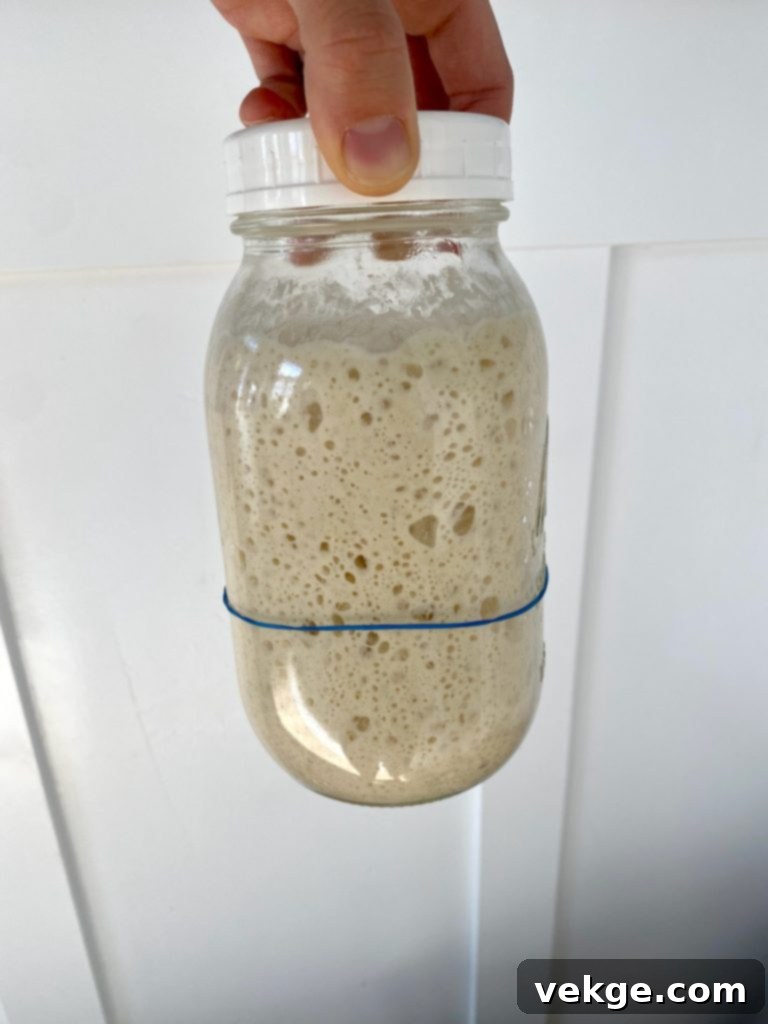
Signs Your Starter Isn’t Ready and Needs More Attention:
- **Flat and Runny Texture with Few Bubbles:** If your starter appears thin, lifeless, and lacks significant bubbling or volume increase after feeding, it’s not active enough.
- **No Rise in Volume After Feeding:** A failure to expand in the hours following a feed is a strong indication of a sluggish or weak starter.
- **Strong Vinegar or Nail Polish Remover Smell:** This sharp, off-putting aroma signifies that your starter is very hungry and has likely over-fermented, producing an excess of acetic acid. It needs a good feeding.
- **A Layer of Liquid (Hooch) on Top:** While a little hooch can be normal, a significant layer indicates the starter has consumed all its food and is hungry. It’s not a problem, but it means the starter is past its peak activity for baking.
Troubleshooting: What to Do If Your Starter Isn’t Activating:
- **Quality Ingredients are Key:** Always feed your starter with unbleached flour (bleached flour contains chemicals that can harm the delicate microbial balance) and filtered water. Chlorine in tap water can act as an antimicrobial agent, weakening or even killing your starter.
- **Optimal Temperature for Fermentation:** Sourdough thrives in warmth. Ensure your starter is left in a consistently warm spot to ferment and activate, ideally between 72°F (22°C) and 80°F (27°C). Cooler temperatures will significantly slow down activity.
- **Nutritional Boost:** To invigorate a sluggish starter, temporarily incorporate a small amount of whole wheat flour or ground rye flour into its feed. These flours are rich in nutrients and enzymes that can give your starter a much-needed boost.
- **”Power Feeds” for Revival:** If your starter is particularly weak, try a series of “power feeds.” Combine 1 tablespoon of starter with 1/4 cup of flour and 1/4 cup of water. Mix thoroughly, cover, and let it sit at room temperature for 12 hours. Repeat this process several times over the next few days until you observe consistent activity.
- **Avoid Contamination:** Be extremely careful to prevent any cleaning products, soap, or anything designed to kill bacteria from coming into contact with your starter or its container. Even tiny residues can severely damage or kill your delicate microbial colony.
The Sourdough Circle of Life:
Runny (hungry) discard → Feed with flour and water → Mix thoroughly → Allow sufficient time to activate → Transforms into bubbly, active starter → Digests all its food → Returns to runny discard → Repeat the cycle! Consistency is key.
How to Prepare Your Starter for a Recipe (Feeding Ratios Explained):
For this cinnamon roll recipe, you’ll need one cup of vigorously active and bubbly starter at its peak. Understanding how to feed and prepare your starter for a specific recipe can initially seem complex, but it quickly becomes intuitive with practice.
I typically prefer using a smaller amount of existing starter relative to flour and water in my feeds. This approach encourages the starter to develop a strong appetite and efficiently digest a larger quantity of “food,” resulting in a more robust and active culture.
For a standard pre-recipe feed, I usually combine **2 tablespoons of runny discard starter + 1 cup of flour + 1 cup of water**. This is approximately a 1:8:8 ratio (1 part starter to 8 parts flour to 8 parts water by weight or close approximation by volume). There’s no absolute need to weigh your ingredients precisely for this ratio; simply mix until you achieve a thick, pancake batter-like consistency. If it’s too thin, add a touch more flour; if too thick, a bit more water.
This feeding ratio will yield ample active starter for the recipe, plus a small reserve to refresh and store in the fridge until your next sourdough baking session. You can also opt for a smaller 1:1:1 feed or a 1:4:4 feed. The general rule is: **the larger the feed (more flour/water relative to starter), the longer it will take for the starter to become active.** Conversely, a smaller feed will activate more quickly.
Given my preference for larger feeds, I find it most convenient to feed my starter (using a 1:4:4 or 1:8:8 ratio) right before I go to bed. It then activates overnight, allowing me to start making the dough first thing in the morning. The dough can then ferment and rise throughout the day, ready for baking in the late afternoon or evening. If I were pressed for time and needed an active starter quickly, I would opt for a 1:1:1 feed, which typically activates in just 2-3 hours.
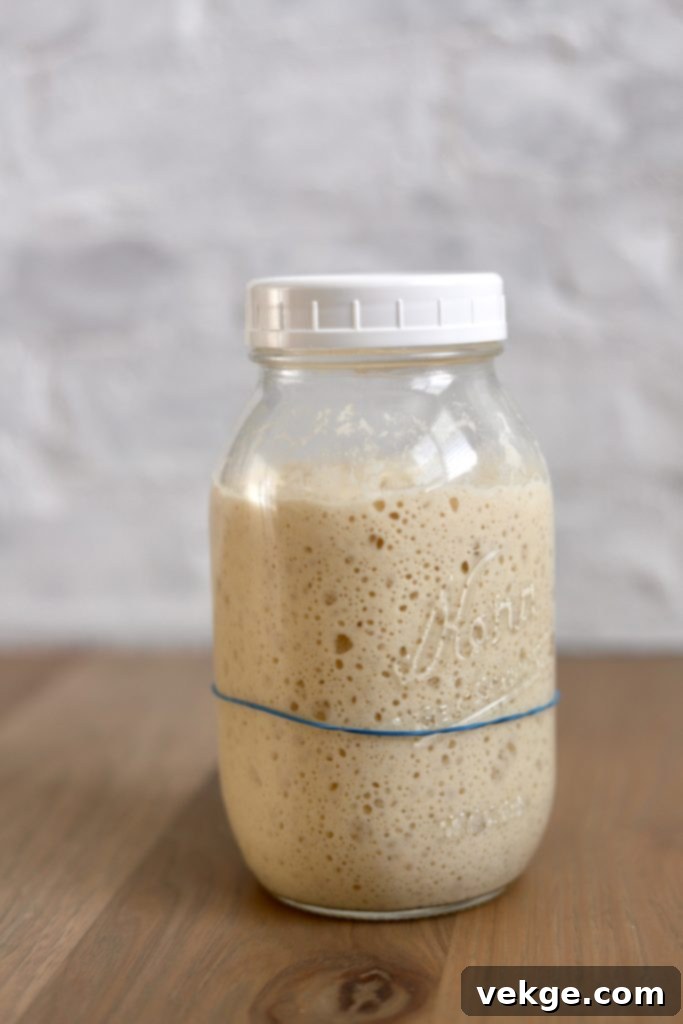
Flour: The Foundation of Your Dough
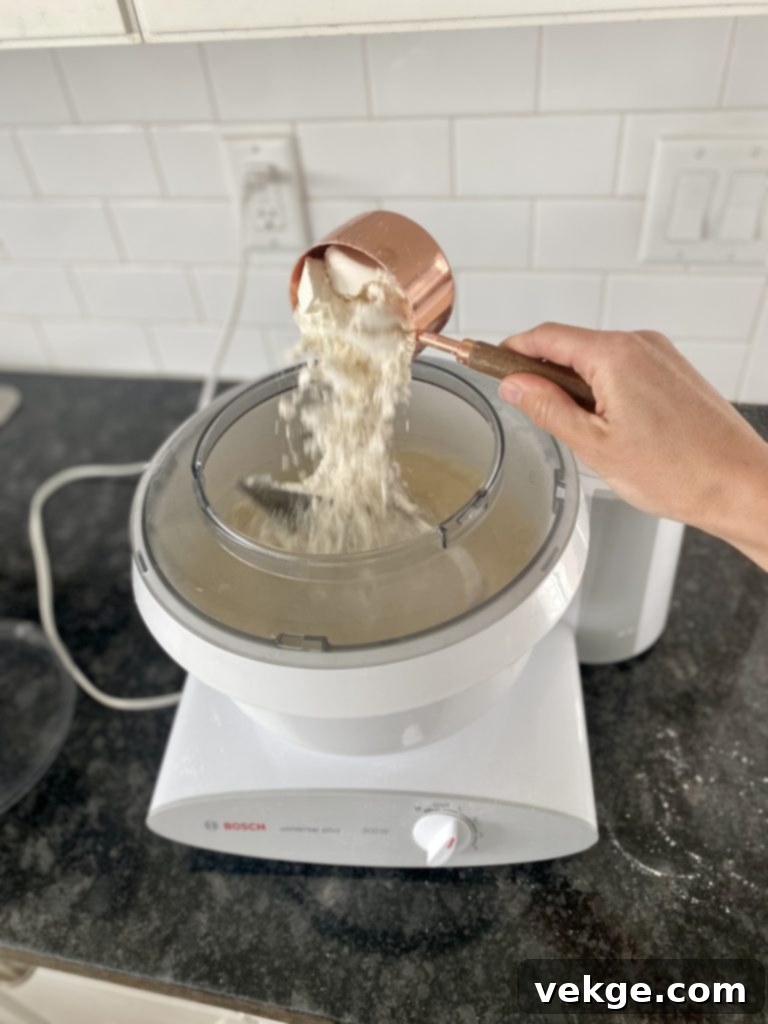
The type of flour you choose significantly impacts the texture, rise, and overall character of your sourdough cinnamon rolls. This recipe is adaptable to several flour options:
BREAD FLOUR: Without a doubt, bread flour is consistently my top choice for sourdough baking. Its higher protein content, typically around 12-14%, means more gluten development, which is crucial for the strong, elastic structure needed to trap the gases produced by sourdough. This results in a tall, buoyant rise and a finished bread that is wonderfully soft with a beautiful, satisfying chew and stretch. Most grocery stores carry bread flour. I frequently use organic bread flour sourced from a local mill like LEHI MILLS (use affiliate coupon code AMBERSKITCHEN for 10% off). I particularly favor their products because they prioritize sourcing wheat from farmers who abstain from using glyphosate on their crops, ensuring a cleaner, higher-quality ingredient.
ALL-PURPOSE FLOUR: All-purpose flour can serve as a direct substitute for bread flour in this recipe. While it has a slightly lower protein content, it will still yield delicious results. For all your sourdough endeavors, I strongly recommend opting for unbleached all-purpose flour whenever possible, as bleaching agents can negatively impact the delicate sourdough culture.
WHOLE WHEAT FLOUR: Incorporating whole wheat flour adds a nutty flavor, a denser texture, and the full nutritional benefits of the whole grain. When substituting whole wheat for bread flour, you’ll generally need slightly less flour due to whole wheat’s higher absorbency and weight. Whole wheat is a “thirsty” flour. For instance, if the recipe calls for 8.5 cups of bread flour, you might only need 7.5 or 7.75 cups of whole wheat flour. Always adjust based on the dough’s texture (it should be tacky but not overly sticky). Be prepared for longer rising times and a slightly less dramatic rise when using 100% whole wheat with sourdough. A wonderful compromise, offering both health benefits and a good rise, is to use a 50/50 blend of whole wheat and bread flour. This strikes a great balance, reducing rise time compared to pure whole wheat while still providing whole grain nutrition.
KAMUT (KHORASAN) FLOUR: Kamut, or Khorasan, is an ancient variety of wheat that has undergone far less genetic alteration than many modern wheat strains. It boasts a distinct, slightly nutty flavor that can add a unique dimension to your cinnamon rolls. Kamut can often replace all-purpose flour, but it’s important to note it’s more absorbent. Therefore, reduce the total amount of flour by approximately 10%-15% when using Kamut. In my experience, Kamut dough tends not to rise quite as high as dough made with bread flour, and the final product can sometimes be a tad more crumbly. I source my regeneratively grown Khorasan locally from KHORASANMILLS.COM (not sponsored), which ships across the United States. It’s an excellent choice for those seeking ancient grain benefits.
Salt: The Flavor Enhancer and Dough Strengthener
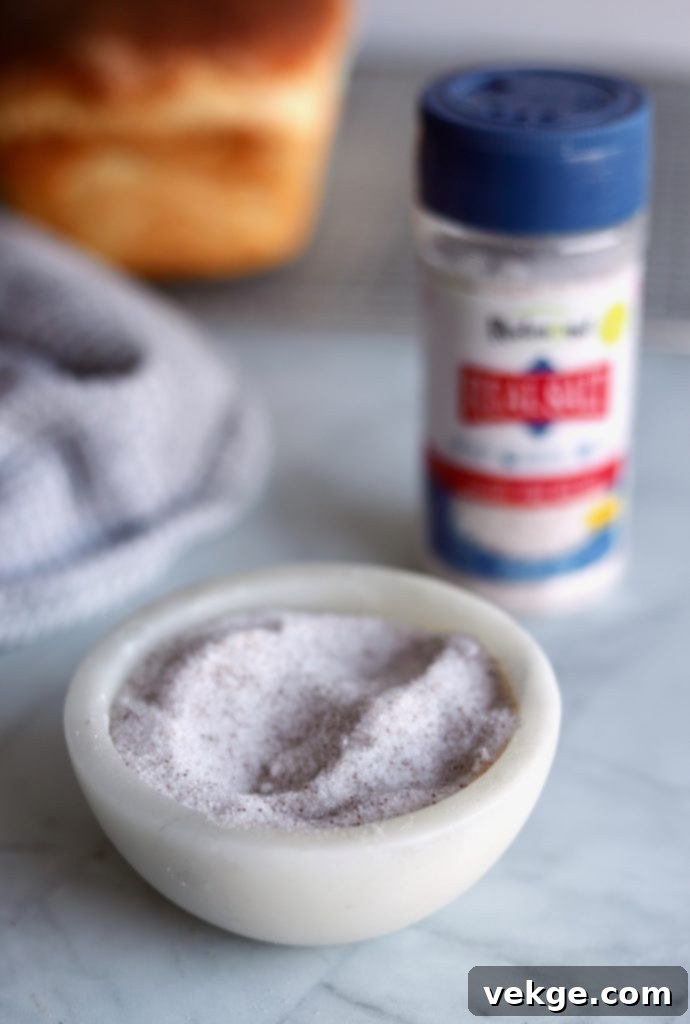
I am quite particular about the salt I use in my baking, and for good reason. My go-to is fine sea salt from Redmond Real Salt, and it’s truly the only salt I ever use. What makes it so exceptional? It’s rich in naturally occurring trace minerals, completely pure, unprocessed, and free from fillers, anti-caking agents, additives, or unhealthy pollutants that are often found in commercial table salt. Sadly, most mass-produced table salts undergo extensive processing, stripping them of beneficial minerals and often including undesirable ingredients.
Redmond Real Salt is meticulously mined from an ancient, pristine sea bed in central Utah, making it a genuine sea salt with a complete mineral profile. Beyond its incredible flavor-enhancing properties, salt plays a crucial role in regulating yeast activity and strengthening the gluten structure in your dough. I purchase my salt HERE. To maximize cost-effectiveness, I often buy in bulk, ordering a 25-pound bag every few years, which I then store in mason jars for long-term freshness.
(Remember to use my affiliate coupon code “AMBERSKITCHEN” to save 15% on any Redmond products. Your purchase through this link supports my work. Thank you!)
Water: The Unsung Hero of Sourdough
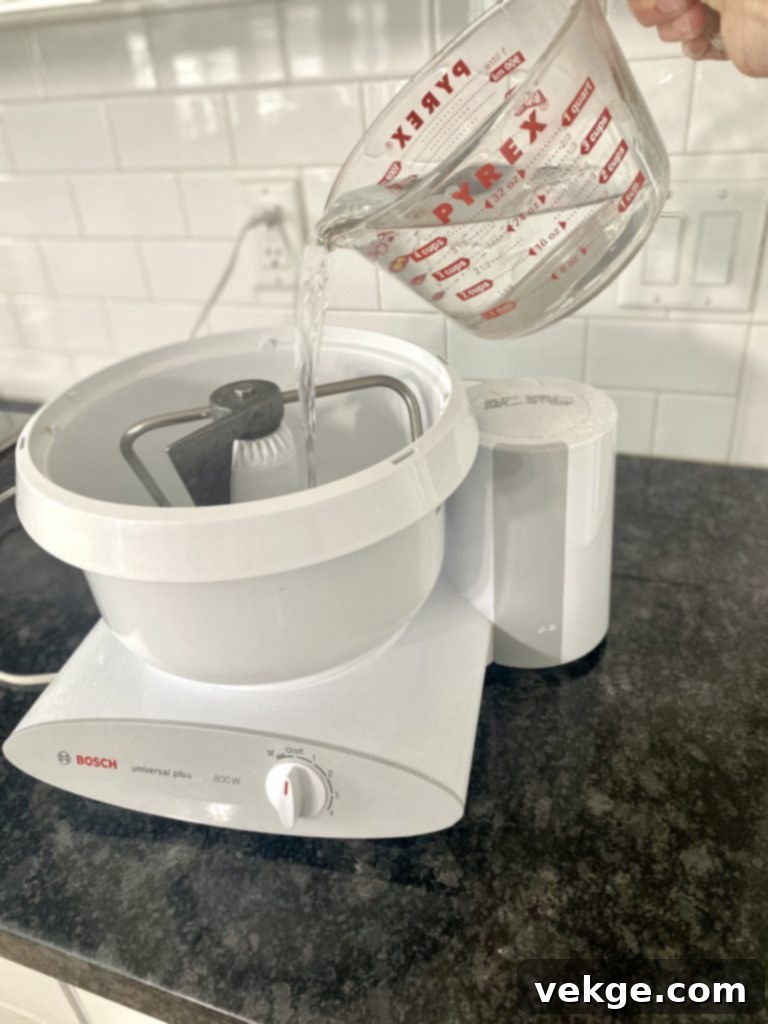
The quality and temperature of your water are far more crucial in sourdough baking than many realize. Aim for room temperature to slightly warm water. Why does temperature matter so much? If the water is too cold, it will significantly inhibit the activity of the natural yeast and bacteria in your starter, leading to extremely slow or failed rises. Conversely, if the water is too hot, it can shock, weaken, or even kill the delicate microbial ecosystem in your starter, effectively rendering it inactive. A gentle warmth provides the ideal environment for the natural yeast to perform its job most effectively, promoting a vigorous and consistent fermentation.
Filtered water is always the superior choice for sourdough. Regular chlorinated tap water contains chemicals designed to kill bacteria – including the beneficial bacteria and yeast strains that make your sourdough starter thrive. Using chlorinated water can act as an antibiotic, potentially weakening the strength and vitality of your sourdough starter and, consequently, your dough. If filtered water isn’t readily available, a simple solution is to fill a cup or pitcher with tap water and let it sit uncovered at room temperature for several hours. This allows the chlorine to evaporate naturally. If you use this method, there’s no need to specifically warm the water afterward, as room temperature will suffice once the chlorine is gone.
While I generally recommend filtered water, I must admit that out of occasional laziness, I have used tap water in my starter and dough, and it has often been fine. This highlights that tap water quality varies significantly by location. Some sourdough bakers report no negative effects from their tap water, while others find it severely detrimental to their starter. Therefore, while filtered water is the safest and best practice, you might find that your local tap water is occasionally permissible, but it’s always best to start with filtered water to ensure optimal conditions for your sourdough.
Sweeteners: Balancing Flavor and Function
For the dough itself, honey is my preferred sweetener. Its natural sweetness and subtle floral notes complement the sourdough beautifully. However, you can easily substitute granulated sugar or even coconut sugar in a straight across 1:1 ratio if you prefer or have those on hand. These alternatives will still yield delicious results.
When it comes to the cinnamon roll filling, the recipe specifically calls for brown sugar, and for good reason. Brown sugar contains molasses, which imparts a rich, deep, caramel-like flavor and a moist texture that is absolutely essential to the classic taste and appeal of the filling. It creates a delightful contrast with the cinnamon, making the filling truly shine.
And for the luscious frosting, powdered sugar is non-negotiable. Its finely milled texture dissolves seamlessly, creating an incredibly smooth, creamy, and velvety frosting. Attempting to use any other type of sweetener here would likely result in a grainy, less desirable texture that simply wouldn’t achieve that perfect, melt-in-your-mouth consistency we crave in a cinnamon roll frosting.
Eggs: For Richness and Structure
Eggs play a dual role in this cinnamon roll dough: they contribute significantly to the rolls’ incredibly soft and tender texture, and they also help stabilize the overall structure of the baked product. Their richness enhances the flavor and crumb.
If you have dietary restrictions or allergies that prevent the use of eggs, fret not! There are excellent egg replacement options available that perform surprisingly well in baked goods:
#1 Aquafaba: This unassuming liquid, typically drained from canned chickpeas, is a miraculous egg substitute, especially for binding and adding moisture. It closely mimics egg in many baked applications and is widely used within the vegan and egg-allergy communities. To use, simply open a can of chickpeas, drain 1/4 cup of the liquid (aquafaba), and use this amount to replace each egg called for in the recipe.
#2 Flax Egg: A flax egg is another reliable plant-based alternative. To prepare one flax egg substitute, combine 1 tablespoon of ground flaxseed meal (ensure it’s freshly ground raw flaxseed for best results) with 2 1/2 tablespoons of water. Stir them together thoroughly and let the mixture sit for about 5 minutes. During this time, it will thicken into a gelatinous consistency very similar to a raw egg, making it ready to use as a direct replacement for one egg.
Should you decide to halve this recipe, you can still confidently use one full egg instead of trying to measure half an egg. The slight increase in richness and moisture will only enhance the final product, and it will turn out great!
Coconut Oil: The Secret to a Delicate Crumb
Years ago, I used to prepare all my bread recipes with vegetable oil. However, after learning about the less-than-ideal health implications of many commercial vegetable oils, I sought a healthier alternative. I decided to experiment with melted coconut oil, unsure if it would work, let alone taste good. To my absolute delight, it not only worked flawlessly but made the bread taste even *more* incredible. Surprisingly, it didn’t impart any coconut flavor to the bread; instead, it resulted in an exquisitely soft dough with the most delicate, tender crumb imaginable. Coconut oil truly is a magical ingredient for bread and other baked goods.
I distinctly remember being one of the first to advocate for coconut oil in bread recipes, sharing this discovery in my own creations. Now, it seems to be catching on like wildfire across the baking community, and I’m thrilled to have been an early proponent. For the absolute best texture in all my doughs, including these cinnamon rolls, I wholeheartedly recommend coconut oil.
If coconut oil is not an option for you, my next recommendation would be to substitute it directly with avocado oil, which offers similar health benefits and a neutral flavor profile, or melted butter for a rich taste. If you don’t have concerns about using vegetable oil, you can certainly proceed with that as a last resort, though you may miss the unique texture enhancement of coconut oil.

Butter: The Indispensable Flavor and Texture Agent
In the filling and frosting for these cinnamon rolls, butter is an absolute cornerstone, and frankly, it’s a non-negotiable ingredient. Its rich, creamy flavor is unparalleled and contributes significantly to the indulgent taste profile. Beyond flavor, butter plays a critical role in the texture of both components: it helps create that luscious, gooey filling when combined with brown sugar and cinnamon, and it is essential for giving the frosting its desired stiff, yet spreadable, consistency. There simply isn’t a direct substitute that will achieve the same decadent results, so I strongly advise sticking with butter for these elements.
Cream Cheese: For the Signature Frosting
Cream cheese is another star ingredient in the frosting, playing a monumental role in creating that iconic, tangy-sweet, and utterly irresistible cream cheese frosting. Its distinctive flavor and velvety texture are what make these cinnamon rolls truly special. It contributes a slight tartness that beautifully cuts through the sweetness, balancing the overall profile and adding a depth of flavor that is simply unmatched by other dairy products.
Almond and Vanilla Extract: Elevating Aromas and Flavors
Extracts are flavor powerhouses that can subtly elevate your baked goods. The almond extract in the frosting is entirely optional, but it introduces a wonderful, delicate nutty note that some people adore. A little goes a long way, so use it sparingly. Feel free to omit it if nutty undertones aren’t to your preference.
Vanilla extract, however, is a different story. Its mild, warm, and subtly sweet aroma and flavor are essential for adding a perfect depth and complexity to the frosting. It harmonizes beautifully with the other ingredients, creating a well-rounded and inviting taste. I genuinely do not recommend skipping the vanilla extract; it’s a small addition that makes a significant difference in the final flavor profile.
Orange Roll Adaptation: A Bright Twist
For those who love a citrusy kick, you’ll be delighted to know that this sourdough cinnamon roll recipe can be easily adapted to create exquisite orange rolls! Here are the simple modifications needed to transform your classic rolls:
First, prepare the sourdough dough exactly as directed in the main recipe, allowing it to go through its full fermentation and rise cycles.
For the filling ingredients, make these key changes: substitute white granulated sugar for the brown sugar. Then, instead of cinnamon, finely zest two fresh oranges directly over the softened butter and sugar mixture. This infuses the filling with a vibrant, aromatic orange flavor. Once the filling is prepared, spread it evenly over the rolled-out dough, then roll up and cut the portions just as you would for cinnamon rolls. Allow them to complete their final rise and bake as normal.
When it’s time to make the frosting, prepare the cream cheese buttercream as described in the main recipe. However, in place of the almond extract, incorporate the freshly squeezed juice and zest of two oranges. Mix everything together thoroughly until smooth and well combined. Spread this bright, citrusy frosting generously over your warm orange rolls. For an extra touch of elegance and flavor, garnish the frosted rolls with a sprinkle of additional orange zest, if desired.

Storage Solutions: Freezing and Refrigerating Your Sourdough Creations
When it comes to managing your sourdough cinnamon rolls, knowing your storage options can be incredibly helpful for meal planning and enjoyment. However, it’s important to understand the nuances of freezing sourdough dough versus baked goods.
Regrettably, I’ve had very limited success with freezing *unbaked* sourdough dough. The delicate ecosystem of yeast and bacteria in sourdough starter tends to be significantly compromised by freezing temperatures. More often than not, once thawed, the dough struggles to regain its leavening power and fails to rise adequately out of the freezer. For this reason, I strongly advise against freezing any pre-baked sourdough dough or formed rolls.
You **CAN**, however, successfully freeze *fully baked* cinnamon rolls! They hold up remarkably well in the freezer when stored in an airtight bag or container. Once thawed, a quick warming in the oven or microwave brings them back to their soft, delicious glory, making them perfect for a quick breakfast or treat.
A much better option for preparing ahead is to **refrigerate the dough before baking**. This method is excellent for those who wish to spread out the baking process or enjoy fresh rolls in the morning without starting from scratch. To do this: after you’ve completed the steps of making the dough, allowing its initial rise, forming the individual rolls, and arranging them on a prepared baking sheet, simply cover the baking pan with an airtight lid or tightly wrap it with plastic wrap. Place the entire pan into the refrigerator, where the dough can slowly cold-ferment for anywhere from 12 to 36 hours. When you’re ready to bake, remove the rolls from the fridge approximately 5-10 hours before your desired baking time. Allow them to come to room temperature and then complete their final rise on the counter until they have nearly doubled in size. Once adequately risen, bake them according to the directions provided in the recipe. This strategy allows for incredible flexibility and ensures you can enjoy freshly baked sourdough cinnamon rolls at your convenience.

Sample Baking Schedule: Harmonizing with Sourdough
Navigating the timing of sourdough baking can initially feel a bit like solving a puzzle, given its reliance on natural fermentation. This sample schedule offers a practical guide based on my own experience, but remember, the beauty of sourdough is its adaptability. Feel free to adjust this timeline to perfectly fit your personal lifestyle and daily routine!
Friday 10:00 PM – Feed Your Starter (1:8:8 Ratio)
Just before you settle down for the night, prepare your starter. In a large glass jar or bowl, combine 2 tablespoons of runny discard starter with a generous 1 cup of unbleached flour and just under 1 cup of filtered warm water. (Adjust the water slightly until the mixture achieves a thick, pancake batter-like consistency when thoroughly mixed.) Stir well, ensuring no dry pockets of flour remain. Cover the container with a lid or plastic wrap, and place it in a cozy, semi-warm spot in your kitchen (ideally between 72°F and 80°F, or 22°C and 27°C) to activate. For easy tracking of its progress, mark the initial height of the mixture on the outside of the glass with a rubber band or a dry-erase marker. Over the next 8-10 hours, your starter should become vigorously active and double in size, so ensure it has ample room to expand!
Saturday 8:00 AM – Prepare the Dough
Before proceeding, confirm your starter has met the criteria: it should be robustly doubled in size, full of lively bubbles, and have a pleasant, tangy aroma. If it hasn’t quite reached this peak, refer back to the sourdough troubleshooting tips earlier in this guide and give it a little more time or a power feed. Once your starter is perfectly active, follow the recipe instructions to combine all the dough ingredients in your stand mixer or a large bowl and knead until smooth and elastic. The dough should be tacky to the touch but not excessively sticky. Cover the kneaded dough with a clean dish towel or plastic wrap, and let it undergo its first bulk rise. This stage requires patience; depending on your kitchen’s ambient temperature and the inherent strength of your starter, this rise can take anywhere from 4 to 8 hours until the dough has noticeably doubled in size.
Saturday 1:00 PM – Form the Cinnamon Rolls
Only move to this step once your dough has fully doubled in size during its first rise. If it needs more time, let it continue fermenting. Once ready, gently turn the risen dough out onto a lightly floured surface. Roll it into a large, even rectangle. Next, generously spread the softened butter over the entire surface of the dough, followed by an even sprinkle of your cinnamon and brown sugar mixture. Carefully and tightly roll the dough into a long cylinder, or “snake.” Trim off the very ends to create neat edges. Using a piece of unflavored dental floss, strong thread, or a very sharp serrated knife, carefully cut the dough log into 16 equal portions for regular-sized rolls, or 12 equal portions for larger rolls. Arrange these dough rounds evenly onto a jelly roll pan (or a 9×13 inch baking dish) lined with parchment paper (or a well-greased baking dish), typically in 4 rows of 4 (or 4 rows of 3). Cover the pan with plastic wrap, a clean dish towel, or a lid, and allow the rolls to undergo their final proof. This rise is complete when the rolls have increased by about 150% in size and appear visibly puffy and soft. This can take anywhere from two to five hours, again varying with conditions.
*Optional Ahead-of-Time Step*: At this point, you have the excellent option to refrigerate the formed dough for 12-36 hours. If you choose this, refer to the “Can I Freeze or Refrigerate?” section above for instructions on bringing them to room temperature and allowing them to complete their final rise before baking.
Saturday 4:00 PM – Bake and Enjoy!
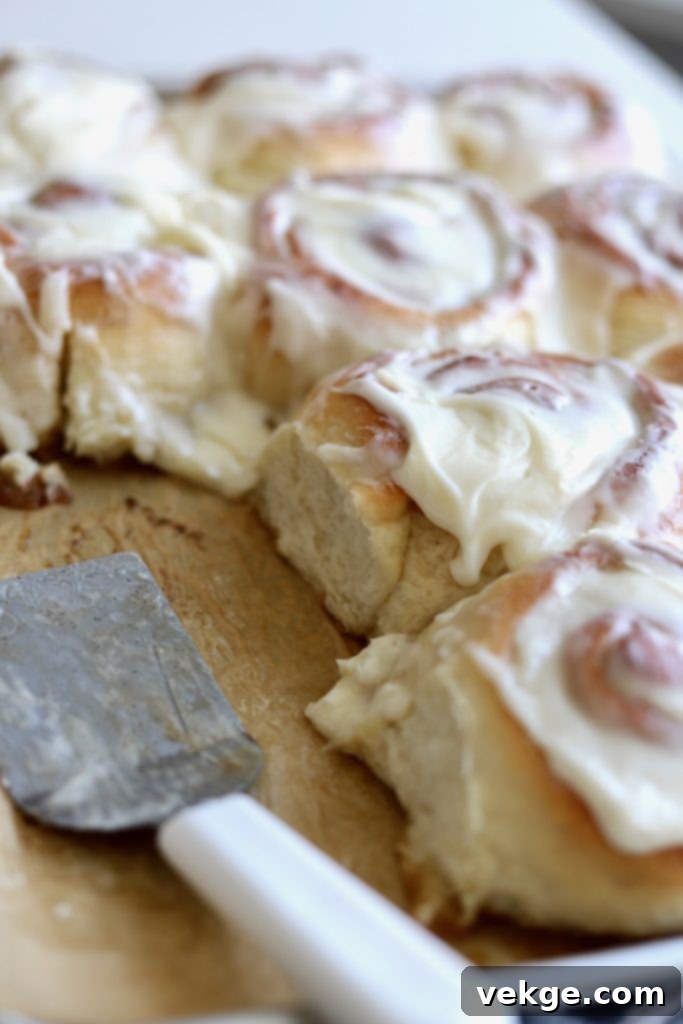
Preheat your oven and bake the cinnamon rolls according to the recipe directions. While the rolls are baking and filling your kitchen with an irresistible aroma, whip up the cream cheese frosting. As soon as the golden-brown, puffy cinnamon rolls emerge from the oven, immediately spread the luscious frosting evenly over them. The warmth of the rolls will allow the frosting to melt slightly, creating an even more delectable experience. Now, it’s time to ENJOY your magnificent homemade sourdough cinnamon rolls!
What Others Are Saying About These Sourdough Delights
Our community of bakers consistently raves about these sourdough cinnamon rolls, praising their unparalleled softness, rich flavor, and the satisfying tang that only natural fermentation can provide. Many have shared their joy in bringing this ancient art into their modern kitchens, discovering the rewarding process and the incredible results. From seasoned sourdough enthusiasts to those new to the journey, the feedback has been overwhelmingly positive, highlighting how these rolls truly stand out as a testament to the power of natural yeast.
(Images of glowing testimonials and happy bakers are typically displayed here, showcasing the delightful outcomes of this recipe.)
Discover More Ways to Enjoy Sourdough
Once you’ve embraced the rhythm of sourdough baking, you’ll find it quickly becomes an indispensable part of your kitchen repertoire and a true culinary companion. The versatility of sourdough extends far beyond just these heavenly cinnamon rolls.
Explore a wider collection of my cherished sourdough recipes HERE, where you’ll find inspiration for everything from artisan loaves to delightful pastries. For specific instructions on crafting homemade sourdough bagels, you can find a comprehensive guide HERE. Dive in and expand your sourdough journey!


Sourdough Cinnamon Rolls
Yes, you can make your cinnamon rolls with sourdough, and yes, they are as mouth-watering as ever! Indulge in soft, rich rolls with the added benefits of natural fermentation.
Course: Sourdough
Keywords: cinnamon rolls recipe, cooking with sourdough, delicious cinnamon rolls recipe, homemade cinnamon rolls, orange rolls recipe, sourdough cinnamon rolls
Prep Time: 30 minutes
Cook Time: 15 minutes
Additional Time: 10 hours (for fermentation and rises)
Total Time: 10 hours 45 minutes
Servings: 12 large or 16 regular-sized rolls
Author: Amber
Ingredients
Dough Ingredients
- 1 3/4 cups warm water (filtered is best)
- 1/3 cup honey (or granulated sugar/coconut sugar)
- 1 cup (220g) active, bubbly sourdough starter (at its peak)
- 1 egg (large)
- 1/4 cup melted coconut oil (or avocado oil/melted butter)
- 1/2 tablespoon Redmond Real Salt (or other fine sea salt)
- 5 – 5 1/2 cups unbleached flour (bread flour, all-purpose, or a blend)
Filling Ingredients
- 5 tablespoons butter, softened
- 2/3 cup brown sugar (packed)
- 1/2 tablespoon ground cinnamon
Frosting Ingredients
- 4 oz butter, softened (1 stick)
- 4 oz cream cheese, softened
- 1/2 teaspoon almond extract (optional)
- 1 teaspoon vanilla extract
- Pinch of fine sea salt
- 2 cups powdered sugar, sifted (add more for thicker frosting, or a splash of milk for thinner)
Instructions
- **Activate Your Starter:** Ensure your sourdough starter is active, bubbly, and has at least doubled in size after its last feeding. (Refer to the “Sourdough Starter” section and “Sample Schedule” above for detailed feeding instructions and activation signs.)
- **Combine Wet Ingredients:** In the bowl of a stand mixer fitted with a dough hook (or a large mixing bowl if kneading by hand), combine the warm water, honey, and your active sourdough starter. Mix gently until well combined.
- **Add Remaining Dough Ingredients:** Incorporate the egg, melted coconut oil, and salt into the wet mixture. Mix thoroughly. Gradually add the unbleached flour, one cup at a time, mixing after each addition. Continue adding flour until the dough pulls away from the sides of the bowl during kneading and feels tacky but not overly sticky when touched. Be cautious not to over-flour, as this can lead to dense rolls.
- **Knead the Dough:** Knead the dough for five minutes, either by hand on a lightly floured surface or using your stand mixer. If using a mixer, you can loosely cover the bowl to help retain warmth.
- **First Rise (Bulk Fermentation):** Transfer the dough to a lightly oiled bowl, turn to coat, and cover it with a clean dish towel, a lid, or plastic wrap. Place it in a warm spot and let it rise until it has increased in size by approximately 50% to doubled. This bulk fermentation can take anywhere from 4 to 7 hours, depending on your ambient temperature and starter’s strength.
- **Prepare for Shaping:** Once the dough has sufficiently risen, gently turn it out onto a lightly floured work surface. Roll the dough into a large, even rectangle, approximately 18×12 inches.
- **Add the Filling:** Spread the softened butter evenly across the surface of the dough rectangle, leaving a small border around the edges. Then, sprinkle the brown sugar and cinnamon mixture uniformly over the butter.
- **Roll and Cut:** Tightly roll the dough up from one long side into a snug cylinder. Trim off any uneven edges. Using a piece of unflavored dental floss, strong thread, or a very sharp serrated knife, carefully cut the dough log into 16 equal portions for regular-sized rolls, or 12 equal portions for larger rolls.
- **Second Rise (Proofing):** Arrange the cut cinnamon roll rounds onto a jelly roll pan (or a 9×13 inch baking dish) lined with parchment paper or greased, leaving a little space between each roll (e.g., 4 rows of 4, or 4 rows of 3). Cover the pan with plastic wrap, a clean dish towel, or a lid. Let the rolls undergo their final proof in a warm spot until they have risen by about 150% in size and appear visibly puffy and soft. This second rise typically takes 2 to 4 hours, again varying with conditions. (See “Can I Freeze or Refrigerate?” section for overnight refrigeration option.)
- **Bake:** Preheat your oven to 375°F (190°C). Bake the cinnamon rolls for 15-16 minutes, or until they are golden brown on top and cooked through.
- **Prepare Frosting:** While the cinnamon rolls are baking, prepare the frosting. In a stand mixer or using a hand mixer, combine the softened butter and softened cream cheese. Beat for about 2 minutes until the mixture is light and fluffy. Add the vanilla extract, optional almond extract, pinch of salt, and powdered sugar. Beat again until the frosting is smooth and creamy. If the frosting is too thick, add a tablespoon of milk (or orange juice for orange rolls); if too thin, add a little more powdered sugar. (Refer to “Orange Roll Adaptation” section if making orange rolls.)
- **Frost and Serve:** As soon as the baked cinnamon rolls come out of the oven, generously spread the prepared frosting evenly over the warm rolls.
- **ENJOY!** Serve warm and savor every soft, tangy-sweet bite.